
Exclusive | The electoral path is the preferred option for transition in Venezuela among Latin Americans, reveals poll
A survey conducted in four countries shows that public opinion supports a democratic transition, while rejecting military intervention.

Faced with the profound political crisis in Venezuela, following the US operation that resulted in the capture of Nicolás Maduro and his wife Cilia Flores, leaving Vice President Delcy Rodríguez in charge, public opinion in four Latin American countries leans overwhelmingly toward an electoral solution, led by the Venezuelan people themselves, rather than solutions imposed by the international community.
The study, conducted by the Worldwide Independent Network of Market Research (WIN), of which the National Consulting Center (CNC) is a member, revealed that 55 percent of respondents in Chile, Colombia, Mexico, and Argentina believe that Venezuelans should return to the polls to elect someone to lead the political transition.
When the results are broken down by country, Mexico and Chile, both with 61 percent, lead in support for this option, while in Colombia (48 percent) and Argentina (43 percent), it is also seen as the most favorable alternative.

Those who favor multilateral mediation by the United Nations (14 percent of respondents) are concentrated primarily in Chile, where this option reaches 21 percent, doubling the average recorded in countries like Argentina (9 percent) and Colombia (7 percent). Similarly, 8 percent overall believe that opposition leaders Edmundo González and María Corina Machado should be in charge of the country.
Support for this leadership is significantly higher in Colombia, where 25 percent of those surveyed prefer them as figures of the transition, compared to 11 percent in Argentina and 7 percent in Mexico.
In contrast, other alternatives—such as a US-led government (4 percent), a regime under Delcy Rodríguez (2 percent), or a delegation of friendly countries (1 percent)—receive considerably less support.
According to Carlos Lemoine, analyst and president of business at the National Consulting Center (CNC), these results reflect the awareness among neighboring Latin American countries of the need for democracy in their region. “Latin American countries, with all their flaws, have a greater need for democracy than anywhere else in the world,” he stated.
The survey also presented a hypothetical scenario of presidential elections in Venezuela among citizens of that country, and the results confirm a clear preference for Nobel Peace Prize laureate María Corina Machado, for whom 57 percent of respondents said they would vote.
However, ahead of González (9 percent), recognized by the international community as the legitimate president of Venezuela after demonstrating his victory with evidence, is Delcy Rodríguez, heir to the power of the Chavista regime, with 11 percent.
Also included in the poll are Nicolás Maduro Guerra (5 percent), son of the ousted Venezuelan leader, and two of the most visible opposition figures: Leopoldo López (3 percent) and, in last place, Henrique Capriles, with one percent.
Support for Maduro's Capture
One of the most striking sections of the survey was related to the capture of Nicolás Maduro by the United States on January 3, so that he could face trial in a federal court in Manhattan.
Fifty-six percent of those surveyed expressed their agreement with Washington's operation in Venezuelan territory, compared to 27 percent who did not support the action and 17 percent who responded that they did not know or did not answer.
The strongest support for this operation was registered in Colombia (63 percent), Chile (61 percent), and Argentina (57 percent); in contrast, in Mexico, less than half—47 percent—stated their agreement. In Mexico, the country geographically closest to the United States, 41 percent of those surveyed expressed their disagreement with Maduro's capture.

Indeed, one of the central themes of the survey focuses on a potential US intervention in Colombia, Mexico, Cuba, and Greenland. Respondents were asked whether they agreed or disagreed with such an operation in these countries.
In this regard, a majority in the region rejects the possibility of US intervention in other countries. Sixty-three percent of those surveyed disagreed with Washington carrying out this type of action, compared to 19 percent who support it.
A comparison by country reveals nuances, but confirms a general trend of rejection. Mexico and Colombia lead the opposition to a potential US intervention, with 68 percent disagreement in both cases. This is significant: these are two countries that have been directly targeted by President Donald Trump, who has even threatened bombings.
Argentina (63 percent) and Chile (56 percent) follow, reinforcing the regional pattern of rejection. Although in every country there is a minority that looks favorably upon these types of interventions —between 13 percent and 23 percent, depending on the case—, support for these actions never manages to overcome the majority opposition.

Potential Intervention Divides Opinions
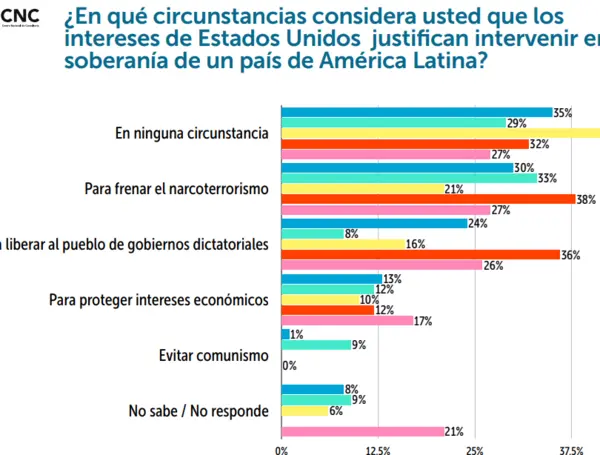
When asked what circumstances might justify US intervention in the sovereignty of a Latin American country, the prevailing response in the region is unequivocal: for a majority, there is no valid justification.
A third of those surveyed—35 percent—believe that foreign intervention should not occur under any circumstances.
However, the study also shows that this rejection is not absolute. A significant portion of the regional population acknowledges exceptions linked to specific threats. The cause that generates the most consensus is the fight against narcoterrorism, mentioned by 30 percent of respondents, suggesting that the problems associated with transnational organized crime continue to be perceived as a challenge that overwhelms state capabilities and could, for some, justify external action.
Another justification that finds significant support is the liberation of peoples subjected to dictatorial governments. Twenty-four percent of those surveyed believe that, in such a scenario, foreign intervention could be legitimate. This support, however, remains below both total rejection and the security agenda.

In contrast, the motivations historically associated with U.S. foreign policy in the region receive minimal support. Only 8 percent of citizens in the four countries consider intervention to protect economic interests legitimate, while a mere 1 percent cite the need to prevent communism as a valid cause.
National differences further highlight these trends. Mexico appears as the country with the strongest opposition to intervention, with 46 percent of respondents stating that it is not justified under any circumstances.
Argentina, for its part, presents a more balanced scenario, with 27 percent categorically rejecting intervention and 26 percent who would accept it within the context of fighting a dictatorship.
Chile, where a presidential campaign recently took place, marked by migration and security issues, is the country with the highest level of support for potential intervention, whether to combat drug trafficking organizations (38 percent) or to prevent the consolidation of another authoritarian regime (36 percent).
Along those lines, Lemoine pointed out that public opinion and concerns are also closely linked to election cycles.
“What happens with public opinion is that it goes dormant when there are no elections: politics ceases to interest people. However, that interest begins to awaken as the elections approach and then acquires a profound meaning regarding where we stand as a society. In that sense, it functions like a mirror,” he said.

The Colombian case also presents unique characteristics. Thirty-three percent of those surveyed believe that the arrival of U.S. troops would be justifiable to combat drug trafficking and terrorism, a figure higher than the percentage who reject this possibility, which stands at 29 percent. Furthermore, Colombia is the country where intervention would be least justified under the argument of confronting a dictatorship, with only 8 percent.
The survey ultimately revealed that a favorable interpretation of the events in Venezuela predominates in Colombia, at least in terms of their impact on the country. A majority of 56 percent of the citizens consulted believe that these events have been positive for Colombia. However, this perception is not uniform: 31 percent of those surveyed maintain that what has happened in Venezuela has not been positive for Colombia, and an additional 13 percent did not know or preferred not to answer.
Article taken from eltiempo.com
By CAMILO A. CASTILLO - International Subeditor
Siempre resulta importante revisar un resultado loteria en una fuente que presente los datos de manera comprensible. Esto permite comprobar la información con mayor tranquilidad y, sobre todo, evita depender de comentarios o publicaciones que puedan estar incompletos o desactualizados.
Green accessories can add a soft, stylish touch to everyday outfits and special occasions. A carefully chosen green necklace can brighten neutral dresses, complement earthy shades, or create a lovely contrast with darker clothing. Pair it with simple earrings or a delicate bracelet to keep the look balanced. Emerald tones suit evening wear, while lighter green shades work well for casual outfits. Choose pieces with clean designs for a graceful appearance without looking too bold. Whether worn with traditional clothing or modern styles, green jewelry can bring charm, elegance, and personality to your overall fashion look.
I wonder how much of that preference for elections assumes a level playing field. In a context where the government controls institutions and media, can a purely electoral route really be seen as viable by voters themselves? The poll is interesting, but I’d like to see follow-up questions on conditions.
<a href="https://nano-bananapro.com/
">nano-bananapro</a>
For NGOs and civic groups working on Venezuela, this is a useful baseline for messaging. If most Latin Americans genuinely prefer elections, then advocacy campaigns should emphasize electoral guarantees and independent oversight, not just regime change rhetoric.
<a href="https://seedance2-5.org/
">seedance2-5</a>
The preference for an electoral path makes sense in principle, but I wonder whether the question assumed elections would be genuinely free and fair. If respondents factored in the current government’s control over institutions, would the answers look different?
<a href="https://nano-banana2.com/
">nano-banana2</a>